

The best and only Louvre museum tour trail you'll ever need
February 2025
The Louvre, in addition to looking simply incredible with its 17th century French renaissance architecture, boasts the richest art collection you will ever find in a museum. It is today one of the most visited places in the world, and each day some 25 000 visitors penetrate its intimacy looking for the unforgettable Louvre experience.
The Louvre is 210 000 square meters of cultural heritage, spanning over hundreds of rooms interconnected in the most French way possible. Visitors often find themselves torn between two approaches: joining a guided tour to ensure they don't miss the highlights or wandering solo, letting chance and curiosity lead the way. Each option has its merits. Guided tours offer in-depth knowledge and structured exploration, ideal for those keen on learning the stories behind the masterpieces. On the other hand, exploring independently allows for a more personal and unhurried experience, where you can savor the museum's treasures at your own pace.
However, there's a third option that combines the best of both worlds: a self-guided trail. This approach lets you maintain your independence while following a carefully designed route that ensures you see the most significant pieces within a reasonable time frame, ideal for people who do not want to spend their entire vacations in a museum. The Louvre offers suggested trails on its official website, which are a great starting point but might not fully capture the museum's potential for discovery.
Having visited the Louvre more times than I can count, I've crafted my own trail, aiming to enhance your experience by including some often-overlooked gems. This guide is perfect for first-time visitors or anyone looking to experience the essence of the Louvre in just 2 to 3 hours—because let's face it, you probably don't want to spend your entire Paris trip inside a museum.
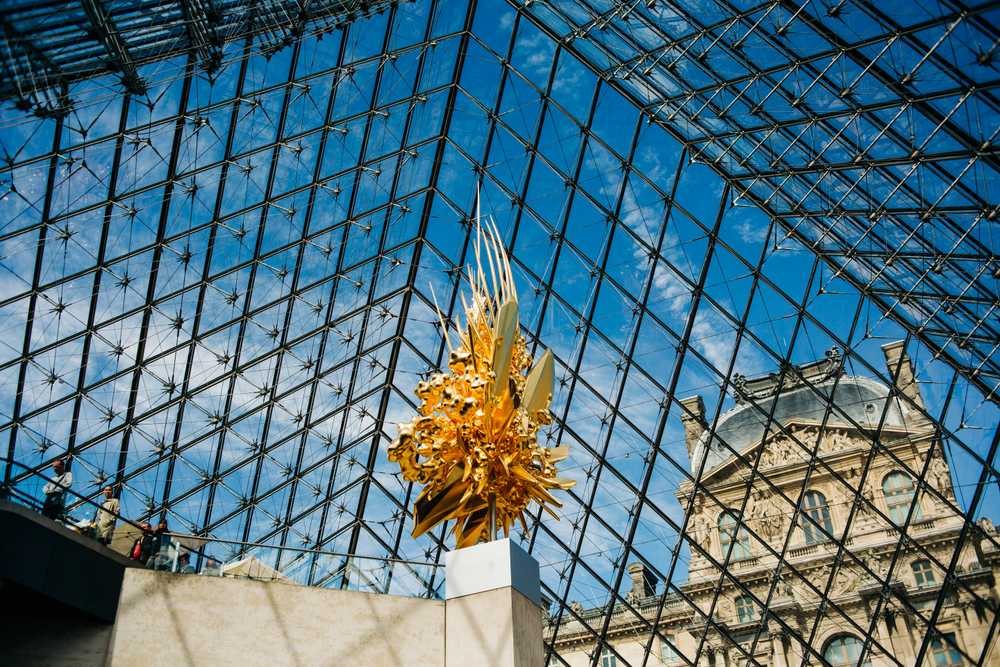 Louvre pyramid, by Jonathan Velasquez
In this article, I'll share a trail that focuses on the best the Louvre has to offer, primarily in the Denon and Sully wings. Here, you'll encounter world-renowned masterpieces like the Mona Lisa, Liberty Leading the People, the Venus de Milo, and the Winged Victory of Samothrace. Additionally, I've included a list of other noteworthy pieces located in different parts of the museum, should you have extra time at the end of your visit.
Enjoy !
Summary:
-
Step 7: welcome to the paintings realm of the Grande Galerie
-
Step 9: taking a look at the British and American paintings of the Louvre
-
Step 10: Romanticism and Neoclassicism go hand-in-hand in Salle Mollien and Salle Daru
Step 1: entering the Denon wing
Assuming you’ve already secured your ticket and discovered that the main entrance to the museum is indeed through the (controversial) glass pyramid, you’ll now find yourself facing three escalators, each leading to one of the Louvre’s three wings.
Before you begin your journey, grab one of the handy museum maps available at the welcome desk. With map in hand, head towards the escalator marked "Aile Denon." After passing through the ticket check, continue down the corridor until you reach the circular staircase on your right—this is where your adventure begins!
Step 2: grand entrance in Salle du Manège
The Salle du Manège might not be the most impressive room in the museum, but it holds many fascinating sculptures. What makes it so interesting is that it is a place in which you can find art pieces from multiple civilizations from different epochs. In this room, Ramsès II meets Alexander The Great meets a dying Seneca, amongst many others...
My two personal favourite pieces of the Salle du Manège are:
Jupyter of Versailles:
A bust of the Roman king of gods. A statue which, in my opinion, faithfully gives Jupyter the imposant and dominant stature that is so characteristic of him.
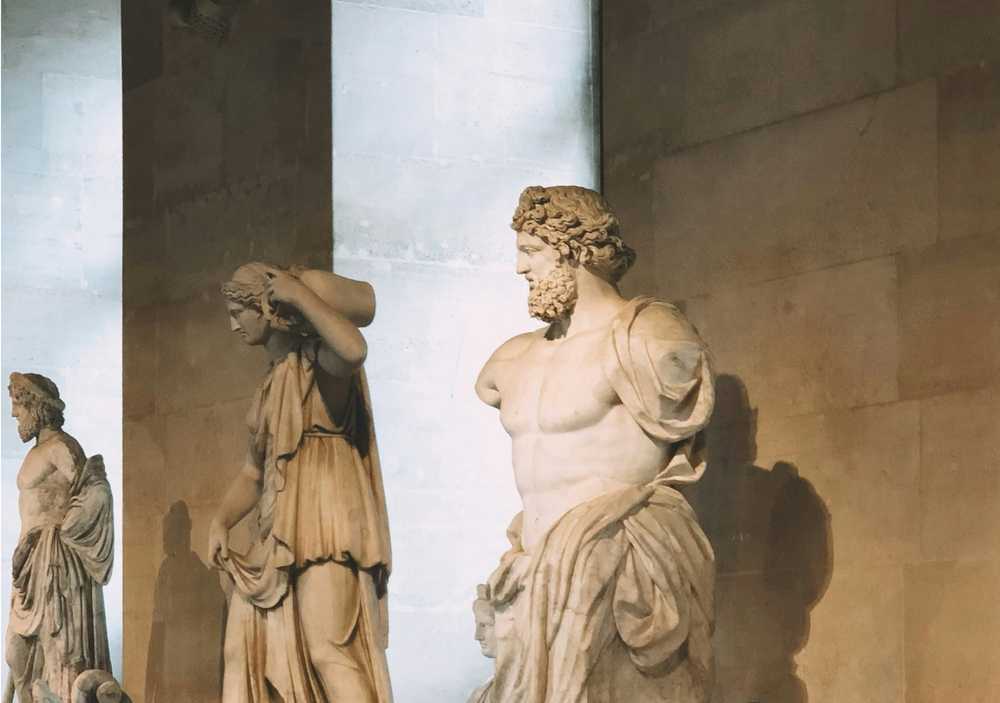 Jupyter of Versailles, by Jon Tyson
The composite statue of Antinous:
The result of the combination of the body of Greek mythology hero Heracles and the head of Antinous, who was Roman emperor Hadrian's lover. After tragically drowning in the Nile, he was deified by the grieving emperor to be forever worshipped as a god. The statue is to be find at the back of the room.
Leave the Salle du Manège through the big double door (which is located right where you popped in when you first took the circular stairs), say hi to the Louvre pyramid peeking through the window, and head left to the Galerie Michel-Ange.
Step 3: first Chefs d'oeuvres in Galerie Michel-Ange
Psyche revived by the kiss of love:
Directly to your left after you come in, you will find Psyche revived by the Kiss of Love, a marble masterpiece which took Venitian artist Canova many years of trial and error before finally being completed. Take a good look at it, because it is one of the most famous sculptures in the Louvre (if not the world).
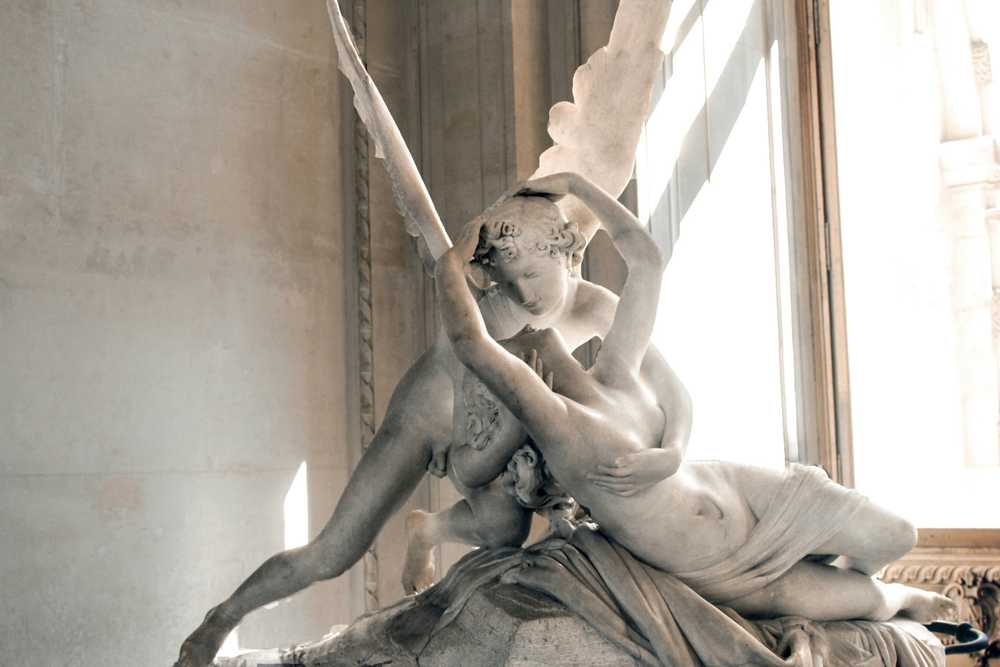 Psyche revived by the kiss of love, by Sara Darcaj
Yet somehow, Canova's beautiful art is not the only star inhabiting the Galerie Michel-Ange, there is another diva in the room and it comes in two distinct sculptures: The Dying Slave and The Rebellious Slave, by Michelangelo.
The Dying Slave and The Rebellious Slave:
I believe there is no need to introduce Michelangelo anymore, the work of this artist of the prodigious florentine Renaissance generation (along with Da Vinci, Raphael, and Donatello) has fascinated the world and has been a notorious subject of study for many scholars. Even though he is mainly remembered for his David and the Sistine chapel's colorful ceiling, every single artpiece by Michelangelo could be considered a masterpiece. The Louvre posesses the twin sculptures of The Dying Slave and The Rebellious Slave, the former being a tad more popular than the latter.
Something that I always find true about Michelangelo's work is that one does not need to be an art expert to be able to appreciate it. You will no matter what find yourself captivated by its tremendous beauty, the genius of this artist was on an entirely different level.
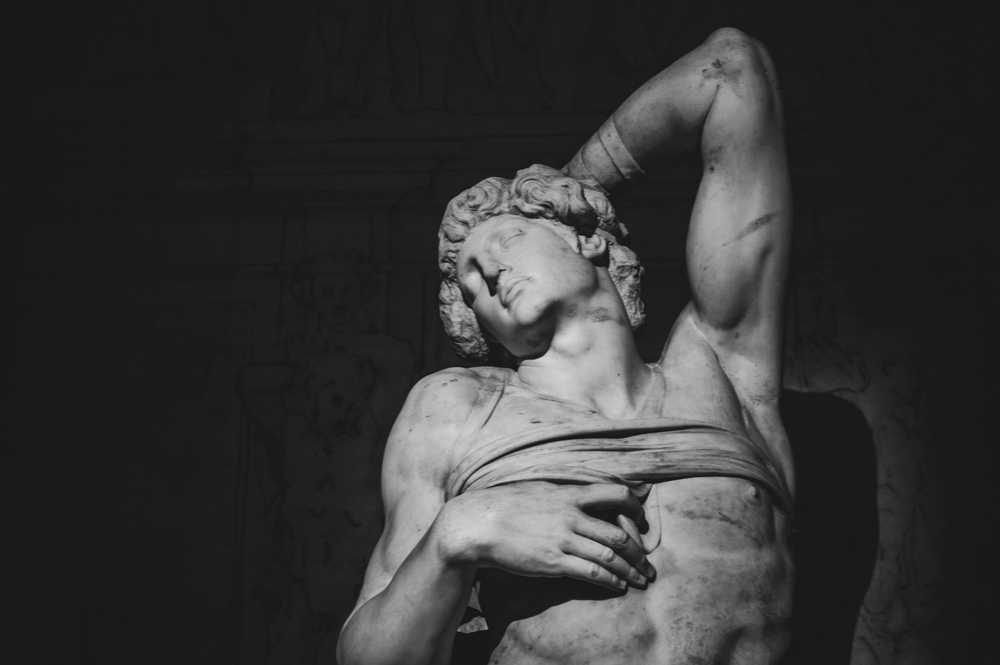 The Dying Slave, by Jean-Baptiste
Instead of passing by the Slaves to go up the stairs sitting behind them, you will now turn around, walk back and leave the Galerie Michel-Ange from where you first entered in, say hi to the pyramid again, and walk forward to the Galerie Daru.
Step 4: Roman imperialism in Galerie Daru
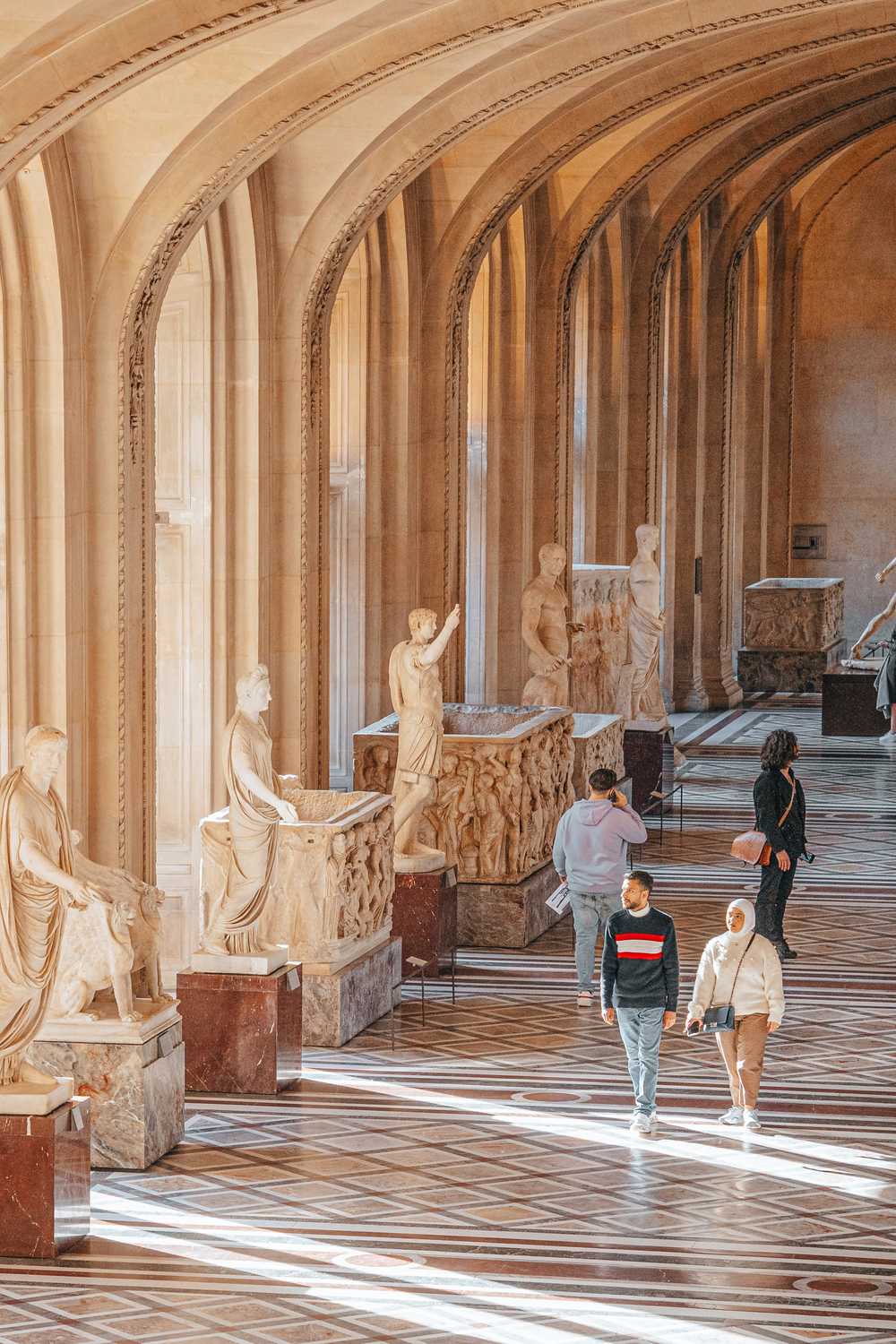
The Galerie Daru is a large room whose two sides are populated by Roman and Etruscan antiquities, mainly status of those quirky Romans we have come to know (and love ?) as emperors. This is the perfect opportunity to put faces on those names you've maybe heard in the past: Augustus, Trajan, Commodus, etc.
The Borghese Gladiator:
For a few years now, the galerie has been home to some important antiquities from the notorious Italian Borghese Galerie, one of them being the Borghese Gladiator, which is considered as one of the most important legacies of the Hellenestic period (323 BCE - 31 BCE). It can be found at the entrance of the room.
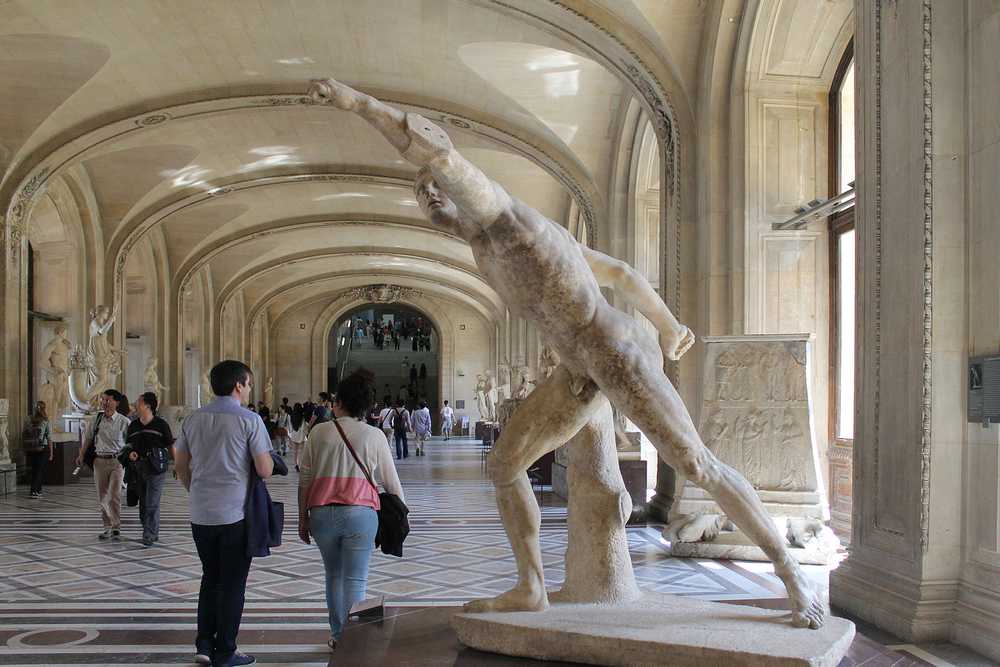 Borghese Gladiator, by Connie Ma (CC BY-SA 2.0)
When you're done admiring the galerie, wave goodbye to the emperors as you cross the room and head to the main stairs.
Step 5: the soaring wings of Palier Samothrace
Now this is a sight to behold !
Atop the colossal main stairs of the Louvre stands a headless Greek Goddess named Niké. With wings widespread, she lands on the prow of a ship, announcing a forthcoming victory for her believers, or perhaps she is ready to take her flight, joining her fellow gods in mount Olympus.
The Winged Victory of Samothrace is perhaps the most important sculpture that popped out of the Hellenestic period. It was discovered by French archaeologist Champoiseau in the island of Samothrace in the northern Aegean sea during the 19th century, and it has ever since been a denizen of the Louvre, one of the many jewels the museum is delighted to exhibit. Despite missing her head and a few limbs, the goddess looks stunning ! It is one of the rare Hellenestic sculptures that endured the test of time and which are not known through Roman replicas.
To fully appreciate the sculpture and all of its majesty, art experts advise not to stand in front of it but rather move slightly sto the right or left so that you could have a 3/4 view of the masterpiece.
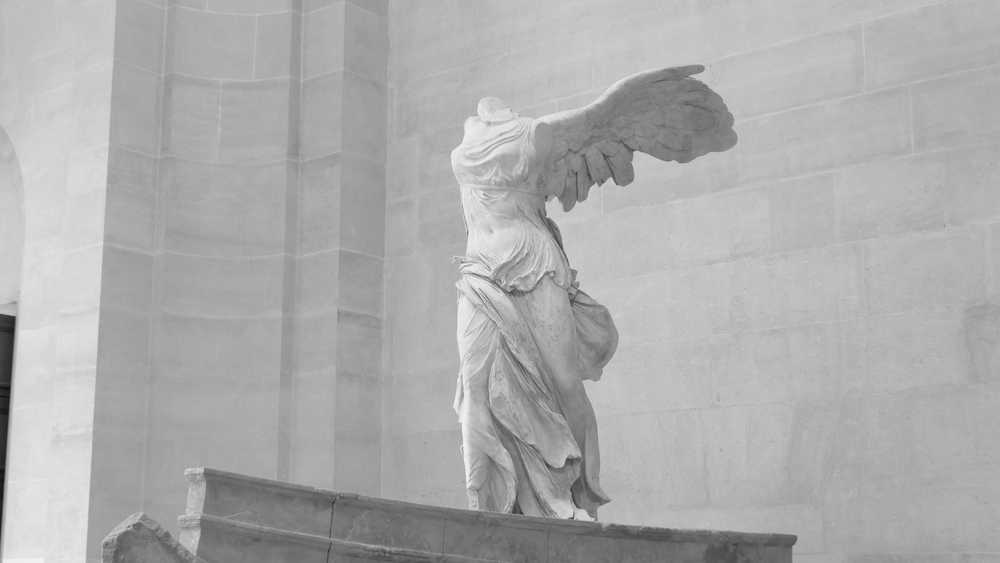 The Victory of Samothrace, by Junhyung Park
Onto our next step ! As you face the statue, go left and enter the circular room known as the Rotonde de la Galerie d'Apollon (in which are engraved the names of the most important and critical donators of the Louvre), then walk right into the worldrenown Galerie d'Apollon.
Step 6: a date with luxury in Galerie d'Apollon
Stupor and amazement are what usually strike people when they first penetrate the Galerie d'Apollon. The room, named after the Greek God of light and arts Apollo, is the closest experience you can get to a Versailles castle visit while inside the Louvre, since it was designed by the same great minds who would architect a few years later Versailles under king Louis XIV's orders. Moreoever, it is because of this room and its symbol that this extravagant monarch began to be known as the Sun King.
In this galerie, anything your eyes lie on is a Classicism gem, but not only figuratively speaking ! Indeed, what is displayed today in the center of the hall is Louis XIV's gem collection, including 3 diamonds that once belonged to old royal families: the Regent, the Hortensia, the Sancy.
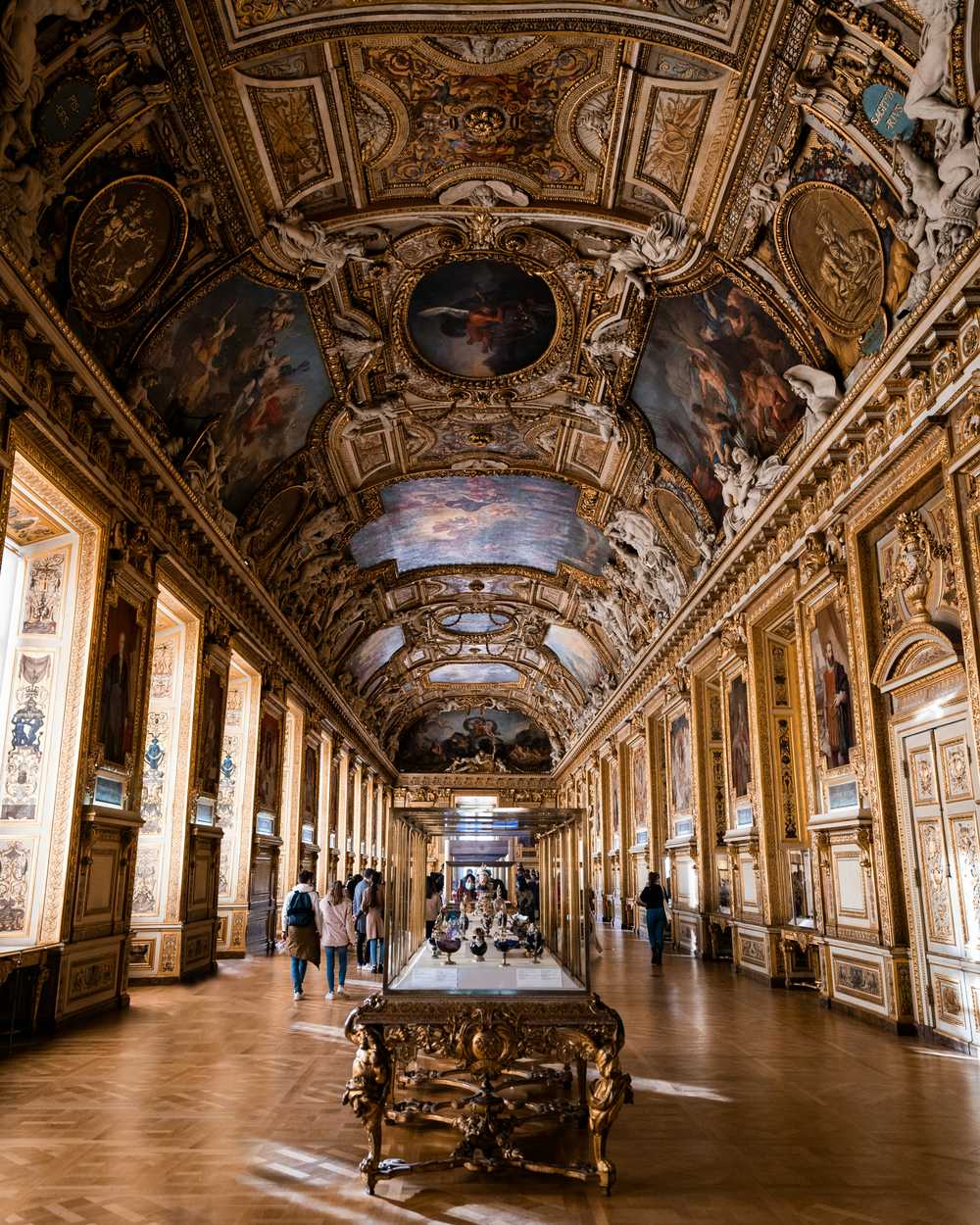 The Galerie d'Apollon, by Dan Asaki
At the back of the galerie, you will find a door that takes you to your next destination.
Step 7: welcome to the paintings realm of the Salon Carré and the Grande Galerie
Salon Carré
Exit sculptures and decorative arts, enter paintings ! (For now at least...)
The Salon Carré, one of the most iconic Louvre rooms, is today filled with paintings of christian subjects. The Virgin, the Christ, and the Biblical Magi (among many others) are the stars of this place. It also posesses one of the most beautifully crafted ceilings that can be found in the museum.
If you happen to be a Sandro Botticelli fan, you will be happy to know that the Renaissance artist has some of his work exhibited in the Louvre. In the Sallon Carré, one can take a look at the The Virgin and the Child and Three Scenes from the Story of Esther, and if you dare exit the room from the right and walk towards the main stairs, you will encounter two frescoes by Botticelli: Venus and the Three Graces Presenting Gifts to a Young Woman and A Young Man Being Introduced to the Seven Liberal Arts. (If you decide to venture to see the frescoes, walk back to the Sallon Carré when you're done).
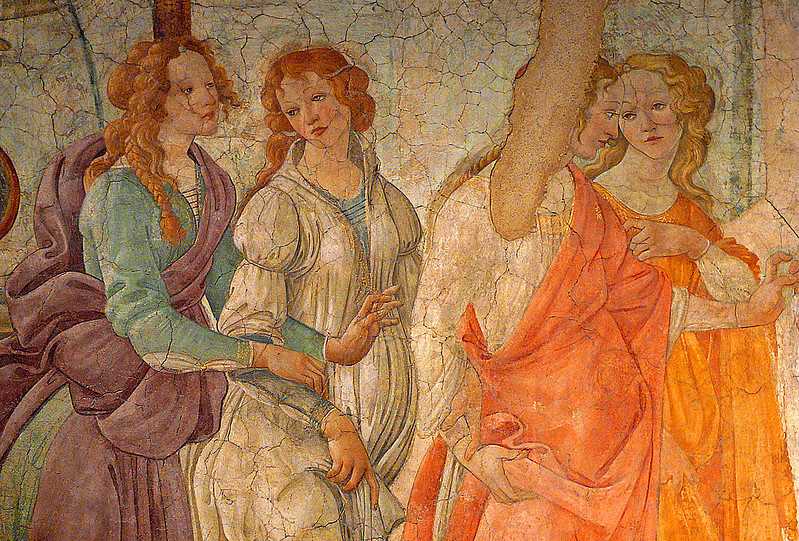 Venus and the Three Graces Presenting Gifts to a Young Woman, by Frans Vandewalle (CC BY-SA 2.0)
Leave through the door that faces the Galerie d'Apollon (from which you came in), and walk into the Grande Galerie.
Grande Galerie
Here is another iconic Louvre galerie, a long majestic hall in which a great collection of Italian paintings is displayed. For a lot of people, this is the image that is conjured when their mind thinks of the Louvre.
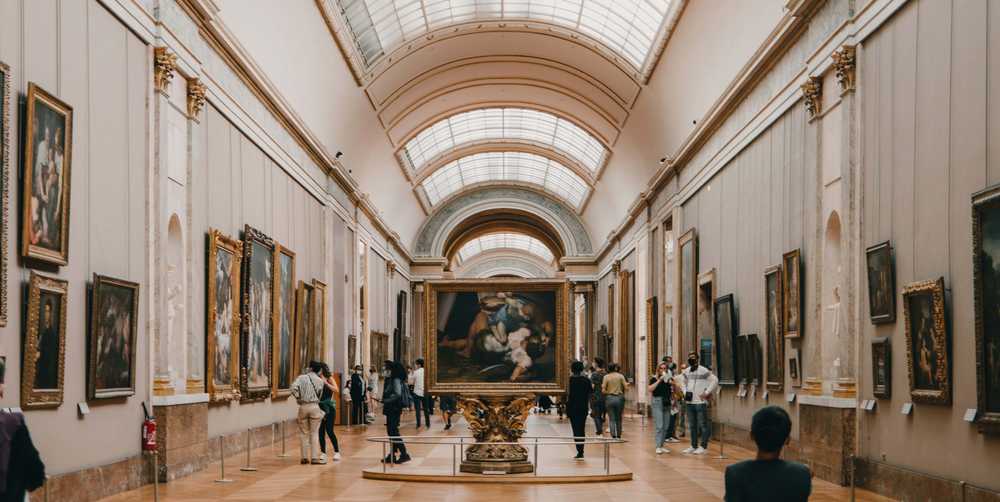
Every artpiece in this galerie is incredible to look at, but the most notable ones are Mantegna's Saint Sebastian, Da Vinci's The Virgin and the Child and La Belle Ferrionnière, and Ghirlandaio's An Old Man and His Grandson.
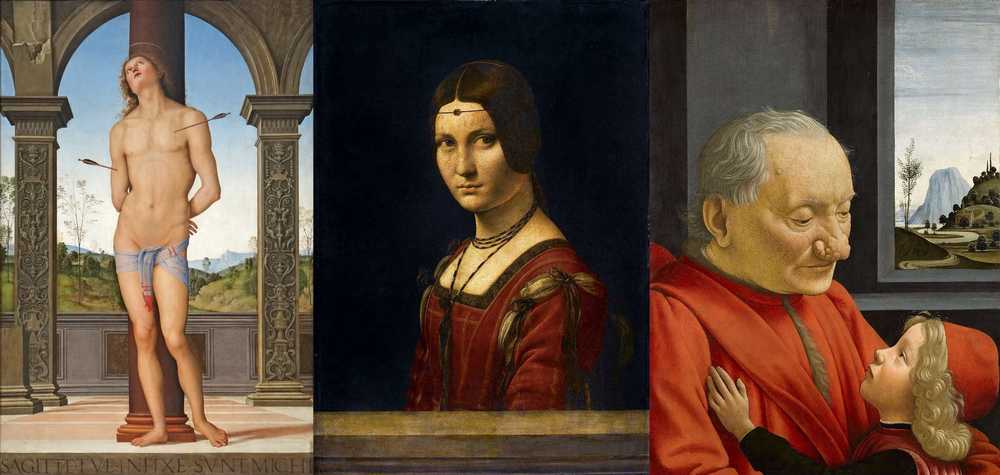 Saint-Sebastian, La Belle Ferronière, An Old Man and His Grandson
Instead of walking through the entirety of the hall, you will follow the Mona Lisa sign into the Salle des Etats for a quick detour to see the Renaissance lady (it is the second turn right in the Grande Galerie).
Step 8: the Italian masterpieces of Salle des Etats
The Mona Lisa
The Salle des Etats is home to the Mona Lisa, the most famous, visited, written about, parodied, but also misunderstood work of art in the world. It was painted during the first years of the 16th century by master Leonardo Da Vinci, and portrays the noblewoman Lisa del Giocondo (who has quite the enigmatic expression on her face). Part of what made the artpiece so famous was its 1911 robbery by Peruggia, an Italian patriot who believed the painting belonged to Italy, even though he tried selling it two years after the theft.

Chances are the room is overcrowded and you find no space to approach Da Vinci's masterpiece. If that is the case, I sympathize with you. But do not despair, one can find in the Salle des Etats other chefs d'oeuvres that are, in my opinion, equally impressive as the Mona Lisa.
Veronese
Starting with the one that directly faces the Italian lady: The Wedding Feast at Cana by Paolo Veronese. In addition to being the largest painting of the Louvre, this monumental painting also depicts 130 different characters, enough for a game of "Where is Wall...Jesus ?".
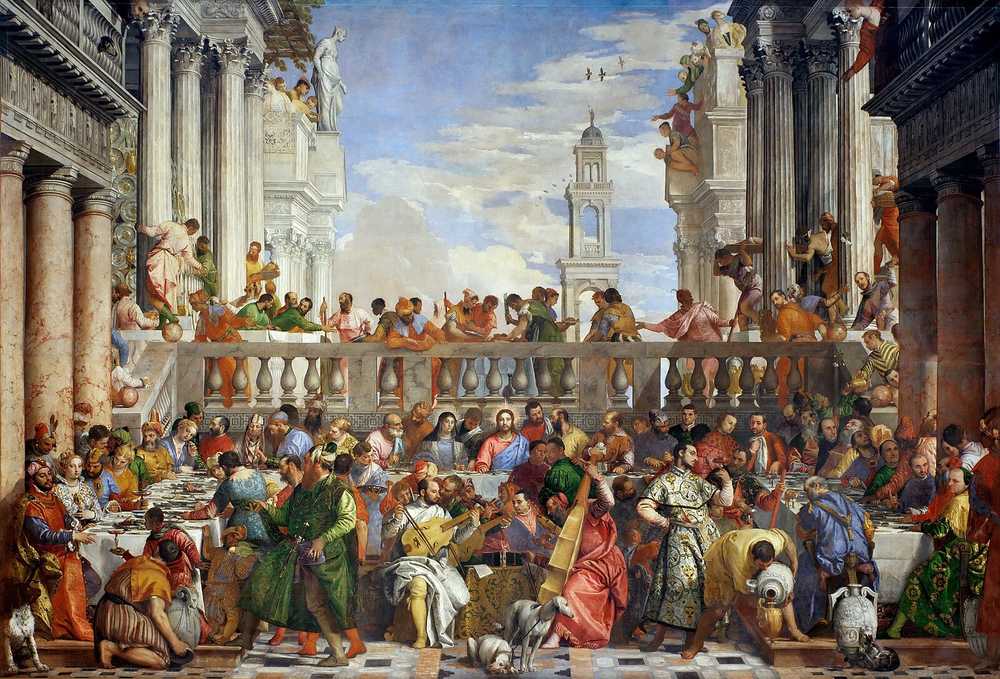
Two other Veroneses that should not be overlooked are Supper at Emmaus, after the biblical story of the Emmaus pilgrims who recognized and invited a resurrected Christ for supper, and Jupyter Hurling Thunderbolts at the Vices, which used to be a ceiling decoration at the Venitian Doge's Palace before being gifted to the Louvre.
Titian and Tintoretto
Somehow, there are even more Renaissance big names who have their work exhibited in the small Salle des Etats, such as the Titian and Tintoretto. These two Venitian artists are experts at using colours, be it the sfumato or the chiaroscuro, and their legacy was a source of inspiration for many future artists, with Tintoretto being known today as the precursor of Baroque art. In this room you can take a look at Titian's Pastoral Concert and Woman with a Mirror, and Tintoretto's The Coronation of the Virgin.
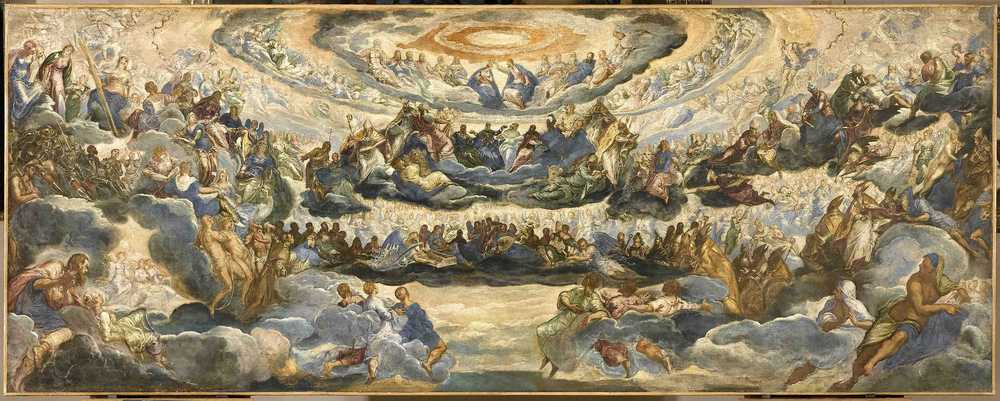 The Coronation of the Virgin, by Lluís Ribes Mate (CC BY-NC 2.0)
Instead of exiting the room through the large door that is behind the Mona Lisa, rejoin the Grande Galerie and keep walking until you find a little door on your right, take it.
Step 9: taking a look at the British and American paintings of the Louvre
Not many American and British artists have reached the notoriety of the Italians, but quite a few have left their mark and influenced many generations to come, amongst them William Turner, Gainsborough, and Reynolds. The Louvre is lucky enough to have some of their art displayed in these two blood-colored dark rooms you are in: Reynolds' Master Hare, William Turner's Landscape with a River and a Bay in the Background, and Gainsborough's famous Conversation in a Park.
Yet, my personal favourite of the room was done by a lesser known British artist who specialized in dramatic landscapes and fantastic compositions: John Martin. His Pandemonium painting never fails to send chills down my spine with its dark religious theme and its serpent-decorated frame (supposedly made by the artist himself).
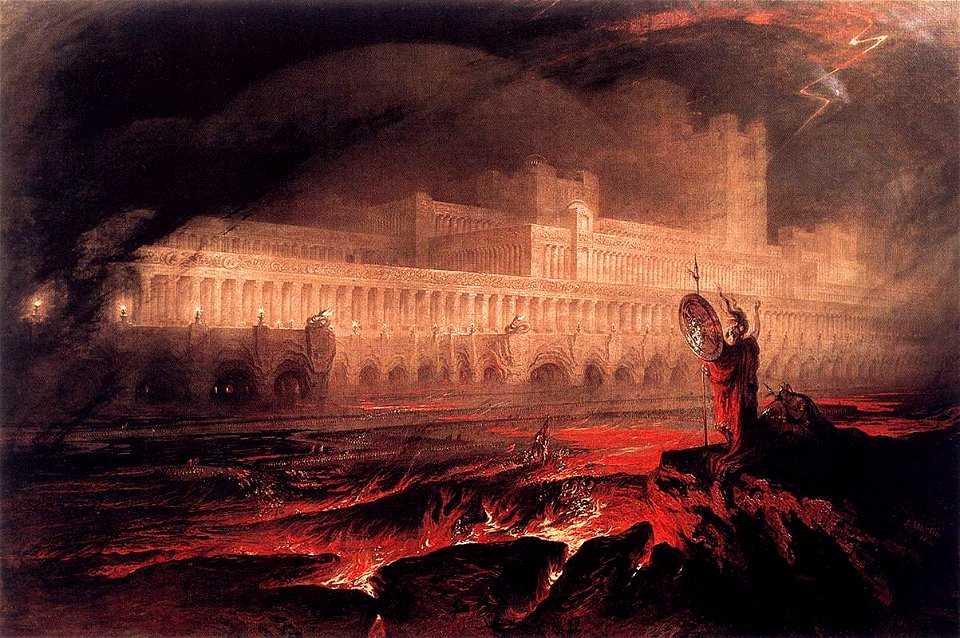
Cross the two rooms until you find the little café Mollien, where you can have some respite if needed, then walk onto Salle Mollien for our penultimate step.
Step 10: Romanticism and Neoclassicism go hand-in-hand in Salle Mollien and Salle Daru
The two rooms you are about to discover are probably my favourite places of the Louvre, god knows how many hours I have spent looking at the masterpieces that hang on their walls. While both of them exclusively exhibit French artists from the 19th century, Salle Mollien, the first one, is dedicated to romanticism, while Salle Daru focuses on the Neoclassicism movement.
Salle Mollien
Romanticism was initially Europe's response to the age of englightenment and the industrial revolution. It is a movement that calls for the appreciation of passion, feelings, and nature, and seeks to bring people closer to their human identity. Although many art experts would argue it is more nuanced than that, it is in a way the antithesis of Neoclassicism (which you will encounter in the next room).
And thus, most of the paintings you will find in Salle Mollien belong to this Romanticism movement, and were made by artists who had a specific goal in mind: to convey emotions to the observer.
.jpg) Detail from Liberty Leading the People, by Larry (CC BY 2.0)
Detail from Liberty Leading the People, by Larry (CC BY 2.0)
Delacroix, great French master of Romanticism, is the author of many of the paintings in Salle Mollien. The most notable ones are Liberty Leading the People, Women of Algiers in their Appartments, Scenes from the Massacre at Chios, and my favourite The Death of Sardanapalus. Fun fact: the latter was seen as an abomination by many of Delacroix's contemporaries when he first unveiled it, only time was able to prove the painter's genius.
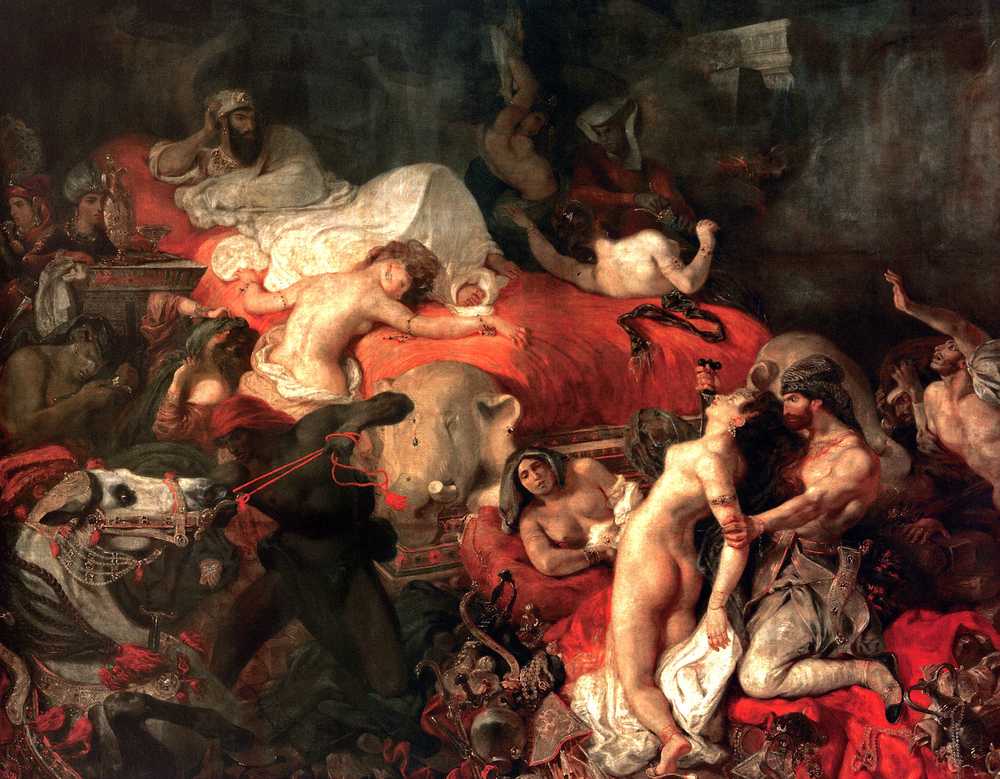 The Death of Sardanapalus, by Lluís Ribes Mate (CC BY-NC 2.0)
Another French renown painter of the 19th century was Géricault, in this galerie you can admire his most precious work: The Raft of the Medusa, which tells (in a dramatic and romantic way) the 18th century story of the French naval frigate Méduse, whose wreck caused the few survivors to endure extreme conditions of starvation and dehydration and resort to cannibalism, only 15 out of 147 survived. This painting is the best example of how Romanticism aims to move the observer, in this case by building in them a sense of sadness and despair.
 Raft of the Medusa (Public Domain)
Cross the galerie, take a look at the little souvenir boutique that occupies the squared Salle Denon if you wish, then enter Salle Daru.
Salle Daru
Neoclassicism was born in opposition to the Rococo style which was the dominating art movement of the 18th century. It focused on simplicity, clarity, and symmetry, and had a clear preference for representing scenes from Greco-Roman antiquity. Neoclassicism eventually had to compete with Romanticism, which had emerged as a reaction to the rigidity and lack of sensuality of the former.
The artist who led the Neoclassicism wave in France was Jacques-Louis David. David is the perfect example of what would be considered today a "history nerd", and this definitely could be seen in his art as he represented many little-known stories from classical antiquity. Some of my favourite David paintings that are exhibited in the Louvre and that I believe should not be missed are The Coronation of Napoleon, Leonidas at Thermopylae, and the eternally beautiful The Oath of the Horatii.
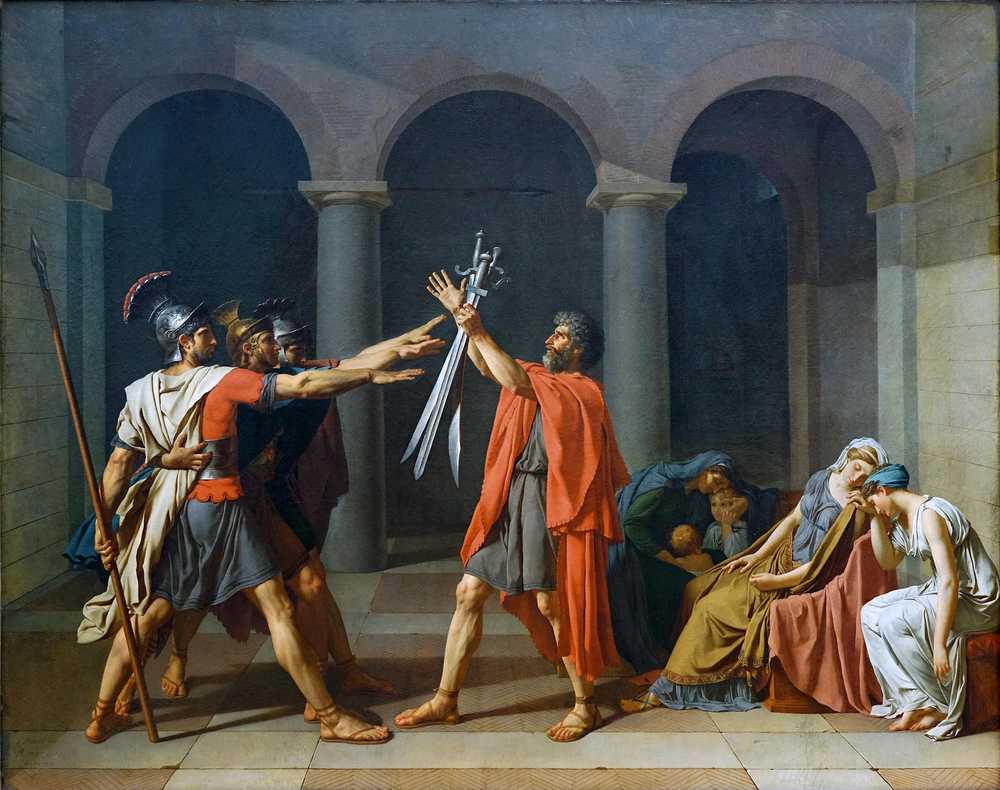
David had many apprentices who history has come to remember as the Davidians, some of them kept his art philosophy alive by following the Neoclassicism route. The most notable ones are Girodet-Trioson, and Ingres, whose work surround their master's in Salle Daru, such as Ingres' Grande Odalisque and The Apotheosis of Homer (which sees Homer deified in the presence of some of history's most influential personnages) and Girodet-Trioson's Scene from a deluge (a representation of the mythical catastrophe known as the deluge, a painting that is actually closer to Romanticism than Neoclassicism).
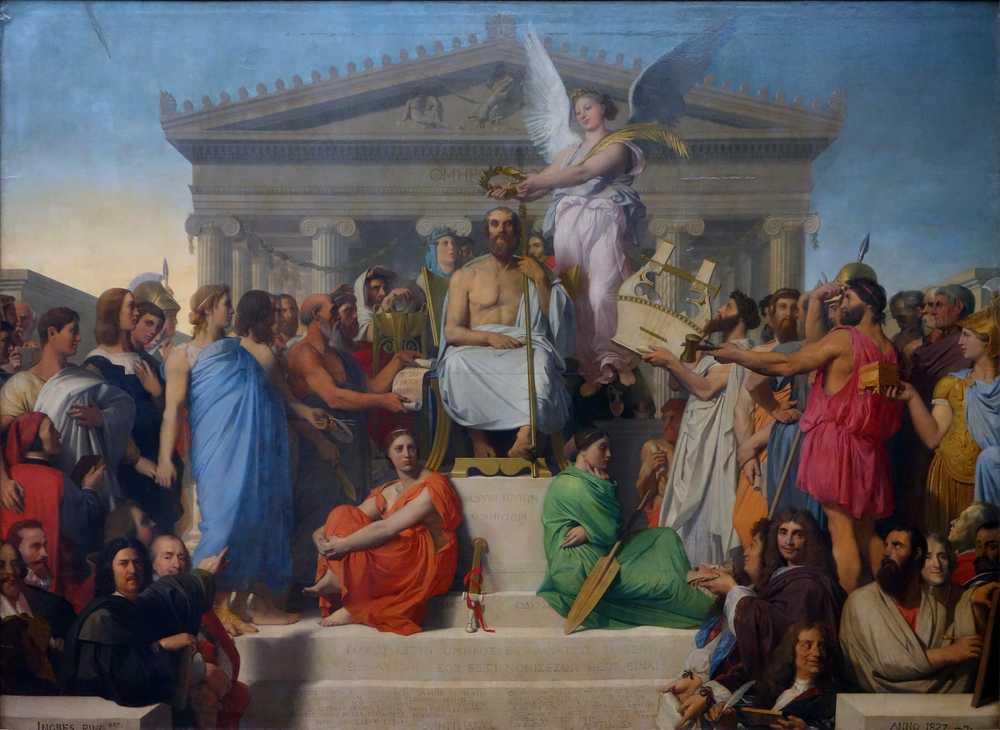 The Apotheosis of Homer, by Steven Zucker (CC BY-NC-SA 2.0)
Leave Salle Daru and take the main stairs but not all the way down. As you reach the first landing, turn right (or left) and walk behind the stairs.
Step 11: Coup de grâce with Greek antiquities
The final step is a series of rooms which display many formidable Greek antiquities. One of these antiquities is the cherry on the cake of this trail and perhaps the most important artpiece the Louvre posesses (after the Mona Lisa): if you walk forward a bit, you will discover on your right the stunning Venus de Milo, a Hellenestic marble statue representing an armless Greek goddess Aphrodite (or Venus according to Roman mythology), which was discovered on the Greek island of Milo (hence the name). The artist is currently unknown. Its first exhibition in the 19th century made quite some noise, as people rushed to the museum to admire Venus' beauty and wonder what the full sculpture must have looked like.
 Venus de Milo, by Tanya Prodaan
What faces the statue are many other beautiful sculptures of Aphrodite/Venus, but if you enter the room that is on the left of the Venus of Milo, you will come upon the historic Salle des Caryatides. The caryatides are the 4 woman-like pillars that hold the entrance/exit of the room. They were sculpted during the 16th century and are inspired by the ones found in Athens' Acropolis.
 Salles des Caryatides, by Wilfredor (CC0 1.0)
This room also accomodates in its center the most famous sculpture worldwide of Artemis/Diana: Diana of Versailles, which depicts the Greek/Roman goddess of the hunt accompanied by a little deer, pulling an arrow from her quiver.
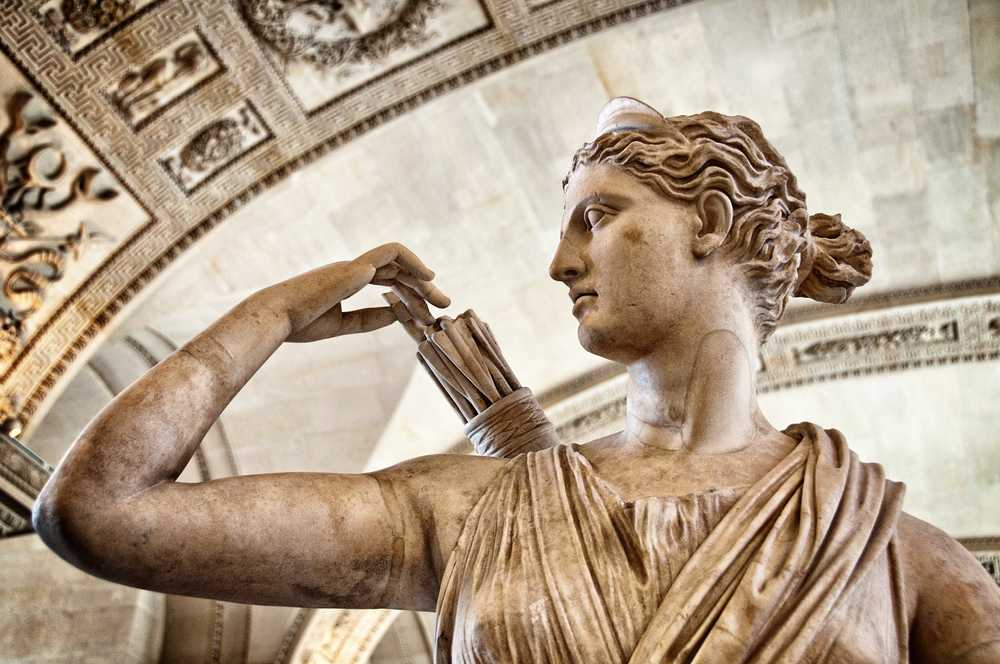 Diana of Versailles, by Peter Mulligan (CC BY-NC-SA 2.0)
This is the end of the trail! When you're done, you can walk through the Caryatides and go downstairs. You will end up in the central plaza of the Louvre.
Other works of art in the Louvre you should not miss:
As I mentioned before, there are many, many others works of art in this gigantic museum that deserve some attention, but since no sane person actually should try to visit the entirety of the Louvre in a single tour, I did not include them in the trail.
What I suggest to you below is a list of masterpieces that can be found in rooms you have not yet visited and which, in my humble opinion, deserve the detour if you have some time on your hand (or if perhaps you plan on visiting the museum again). Otherwise, I deeply hope the tour was very pleasing and easy to follow, and that it made you fall in love with this culturally rich place as much as I do.
The Code of Hammurabi:
I'm a big sucker for Mesopotamia history, and even though it is terribly underrated, I present to you one of Mesopotamia's most important legacies: the Code of Hammurabi. On this black basalt stele is inscribed some of the world's first laws ever, written in the Akkadian language by Babylonian king Hammurabi in the 18th century BCE. You can learn about some of its rules on the posters that accompany it.
Location: room 227, level 0, Richelieu wing.
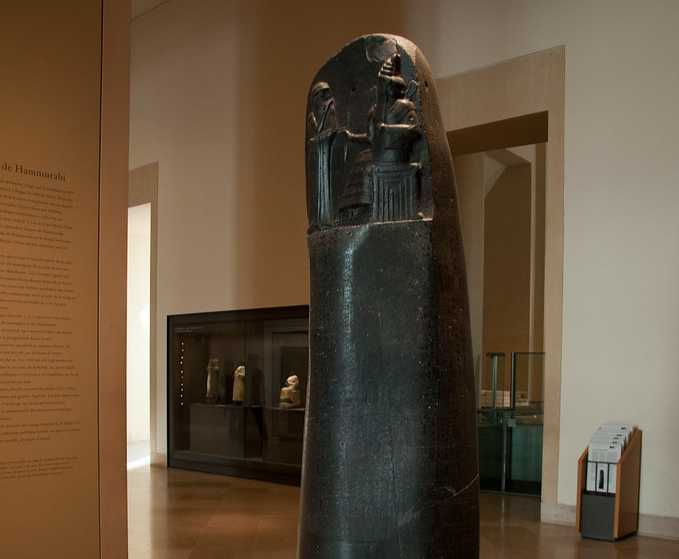 The Code of Hammurabi, by Wendy (CC BY-NC-ND 2.0)
The Palace of Sargon II (The Khorsabad Courtyard):
Delve into the beautiful palace of Assyrian king Sargon II, decorated with plenty bas-reliefs and Lamassus (winged creatures with the lion bodies and kings faces, meant to prevent bad spirits from entering the palace).
Location: room 229, level 0, Richelieu wing.
.jpg)
The Marly and Puget Courtyards:
You have most probably already seen pictures of these places, and you might even have been excited to visit them, and subsequently disappointed to find out they weren't part of the tour (if that's the case, sorry, it was hard to fit everything !).
Nevertheless, it's always possible to enter the Richelieu Wing to enjoy these two beautiful piazzas, which are inhabited by stunning French sculptures. Do not miss out on the Horses of Marly!
Location: rooms 102 and 105, level -1, Richelieu wing.
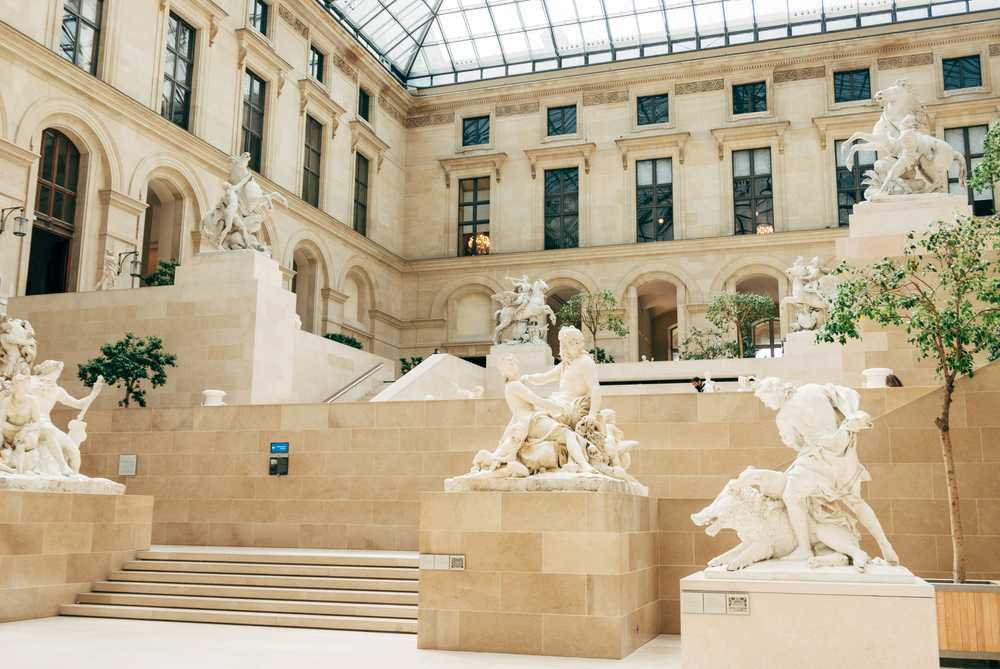 The Marly Horses in the Marly Courtyard, by Alex Harmuth
Napoléon III's apartments:
As you may know, the Louvre has not always been a museum, it has previously served as the residences of both kings and emperors. Today, you can visit the recently renovated apartments of Napoléon III. Luxurious decorative objects and pretty colours are on the agenda.
Location: level 1, Richelieu wing.
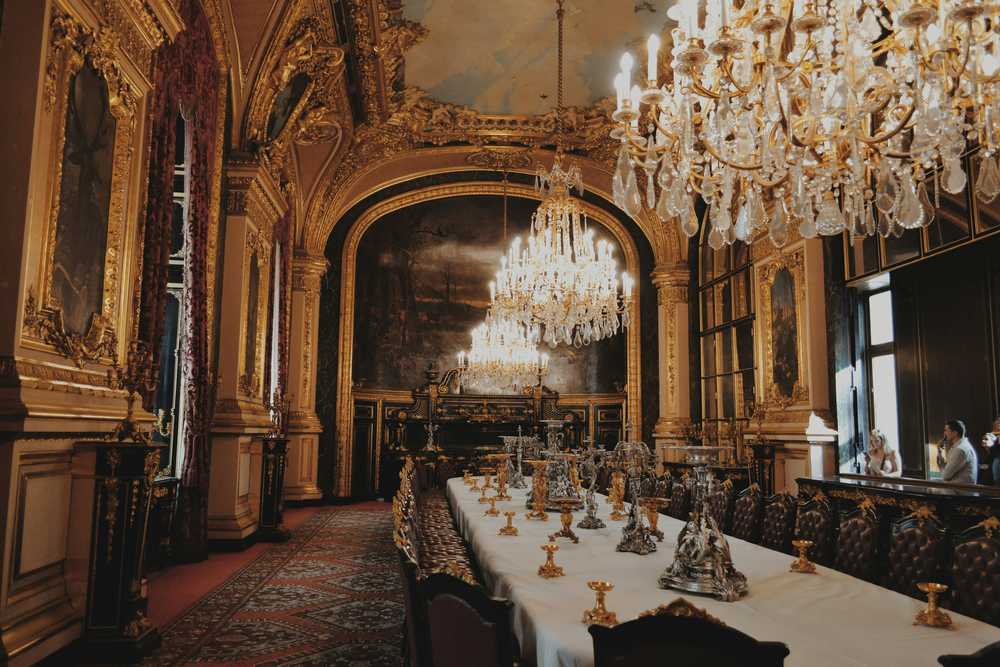 The Apartments of Napoléon III, by Amy-Leigh Barnard
The Seated Scribe:
The only Egyptian sculpture of this list, the Seated Scribe is one of the Louvre's treasures. It represents a sitting scribe (ie: a man whose job was to write administrative or religious texts, akin to an official today). What makes the limestone statue so popular is the incredible state in which it was found, the paint was almost intact.
Location: room 635, level 1, Sully wing.
